The two-day ENDORAMA conference, which has been organized for the past five years by faculty members of the Department of Medicine at the University of Patras, in addition to its purely scientific focus on the contemporary literature of endocrinology, is complemented by the CULTURAL ENDORAMA:a cultural event held in parallel with the two-day conference, featuring a distinct thematic focus each year, which highlights aspects and characteristics of Western Greece and Patras in particular.
This is an effort by the organizing committee to go beyond the boundaries of science, to “engage” with society, and to highlight initiatives and characteristics of the wider region. In previous years, the conference was dedicated to: (a) the refugees of Patras; (b) Mesolonghi and the lagoons surrounding it; (c) Kalavryta and its role in the Revolution; and (d) to theater and the Patras Municipal and Regional Theater.
Every year, exhibitions (visual arts, history, and costumes), recitations, music, and gastronomy come together to paint a picture of the chosen theme.
In 2013, the CULTURAL ENDORAMA took a new direction. It expanded beyond the borders of Western Greece and reached out to the global community. It dedicated its cultural focus to the European Organization for Nuclear Research (CERN), the world’s largest experimental particle physics research center, located west of Geneva on the border between Switzerland and France.
CERN was founded in 1954 by twelve European countries (including Greece), and today not only EU member states but also the United States, India, Israel, Russia, Japan, Turkey, and UNESCO.
At the conference’s opening ceremony , Konstantinos Zioutas, Professor Emeritus of Physics at the University of Patras, who has been working at CERN since 1976, introduced the delegates to this global endeavor, while at the same time, a photo and video exhibition showcasing CERN’s identity was on display in the foyer of the SPK.
On behalf of “ENDORAMATOS,” we would like to thank everyone who supported us:
Konstantinos Zioutas, Professor Emeritus of Physics at the University of Patras, who readily accepted our invitation and prepared an impressive speech for the opening ceremony.
Yannis Pikramenos, the conference organizer, who once again embraced and highlighted in a special way not only the organizational and academic aspects of ENDORAMATOS, but also its cultural dimension.
Historian and archaeologist Androniki Chrysafi, who has served as curator of the “Cultural Endorama” since its inception and, with great care, passion, expertise, and fruitful discussions, she contributes to its realization every year.
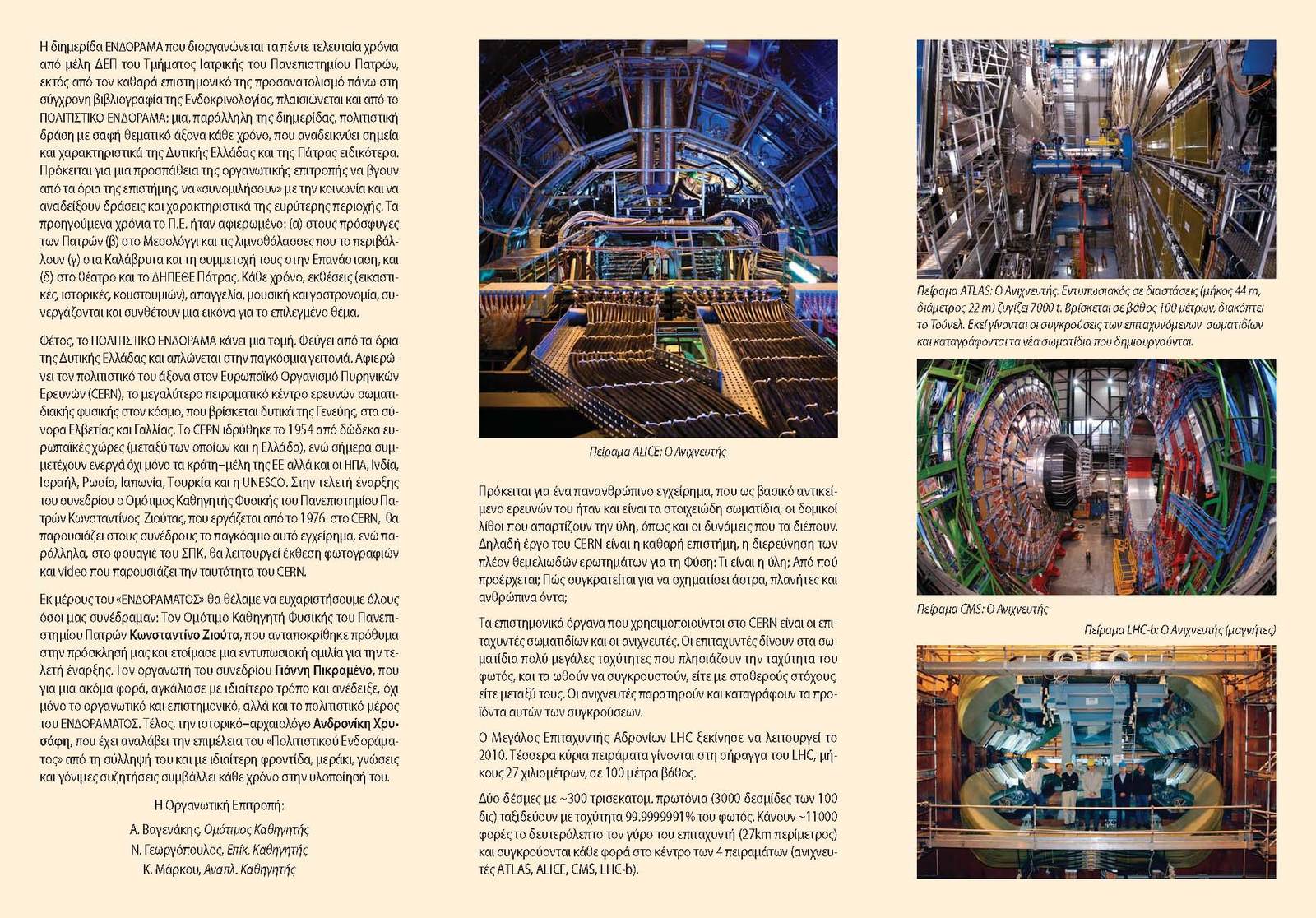
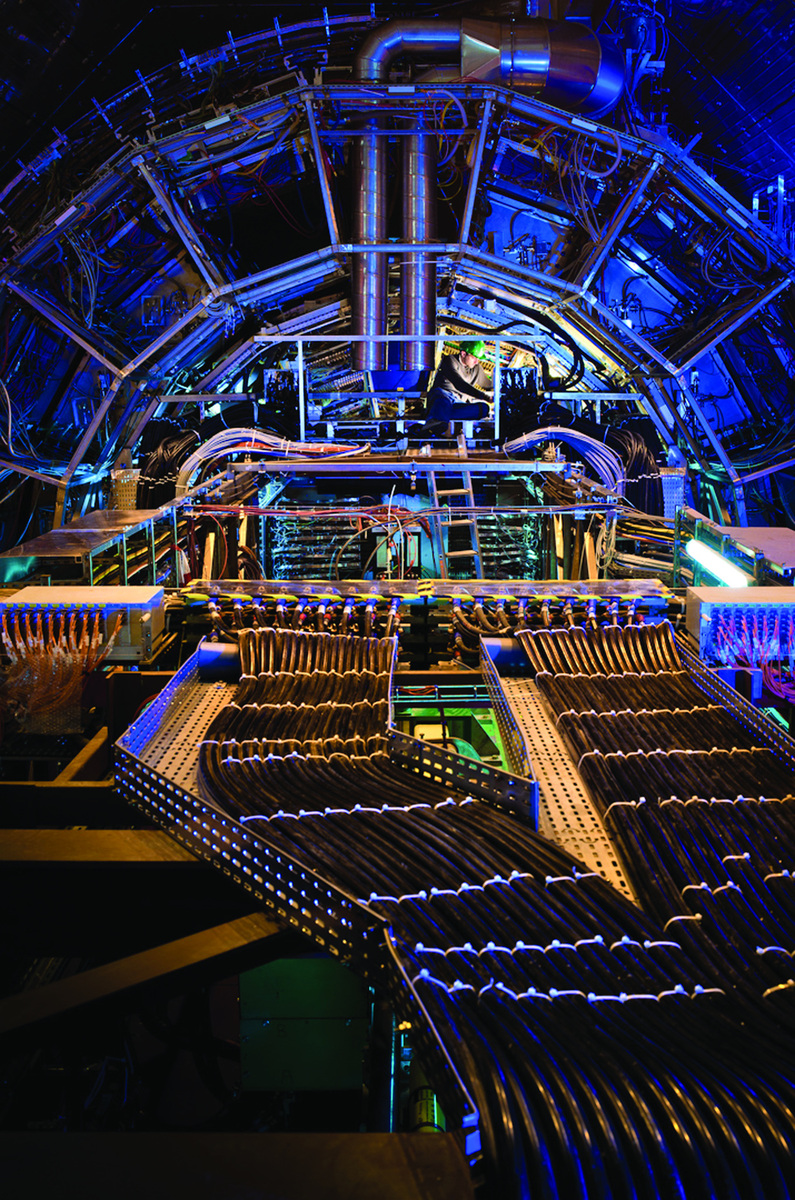
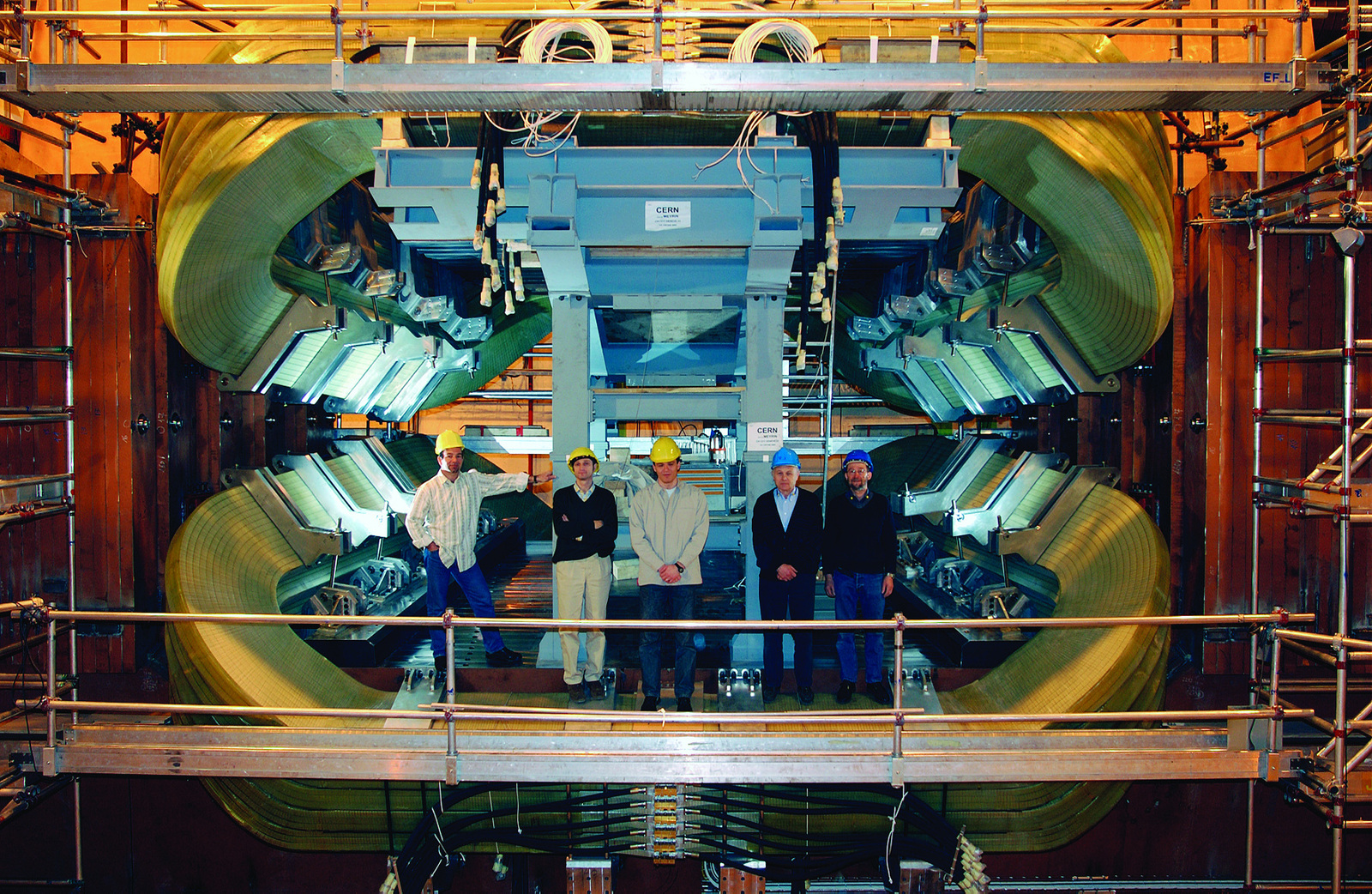
The ALICE Experiment: The Detector
This is a universal endeavor, whose primary focus of research has been and remains elementary particles, the building blocks of matter, as well as the forces that govern them.
In other words, CERN’s mission is pure science—the exploration of the most fundamental questions about Nature: What is matter? Where does it come from? How does it hold together to form stars, planets, and human beings?
The scientific instruments used at CERN are particle accelerators and detectors. The accelerators give the particles very high speeds approaching the speed of light and cause them to collide, either with fixed targets or with each other. The detectors observe and record the products of these collisions.
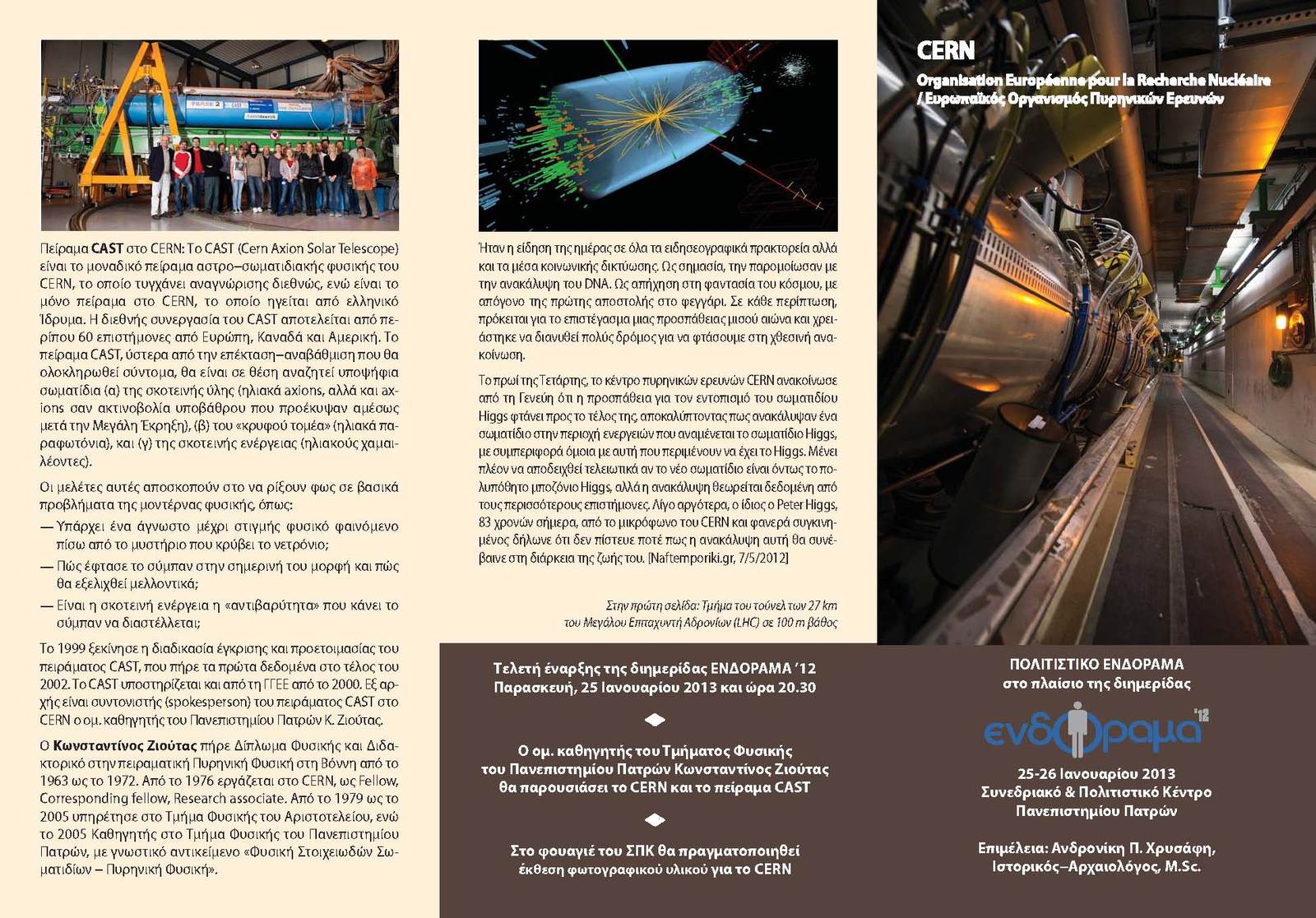
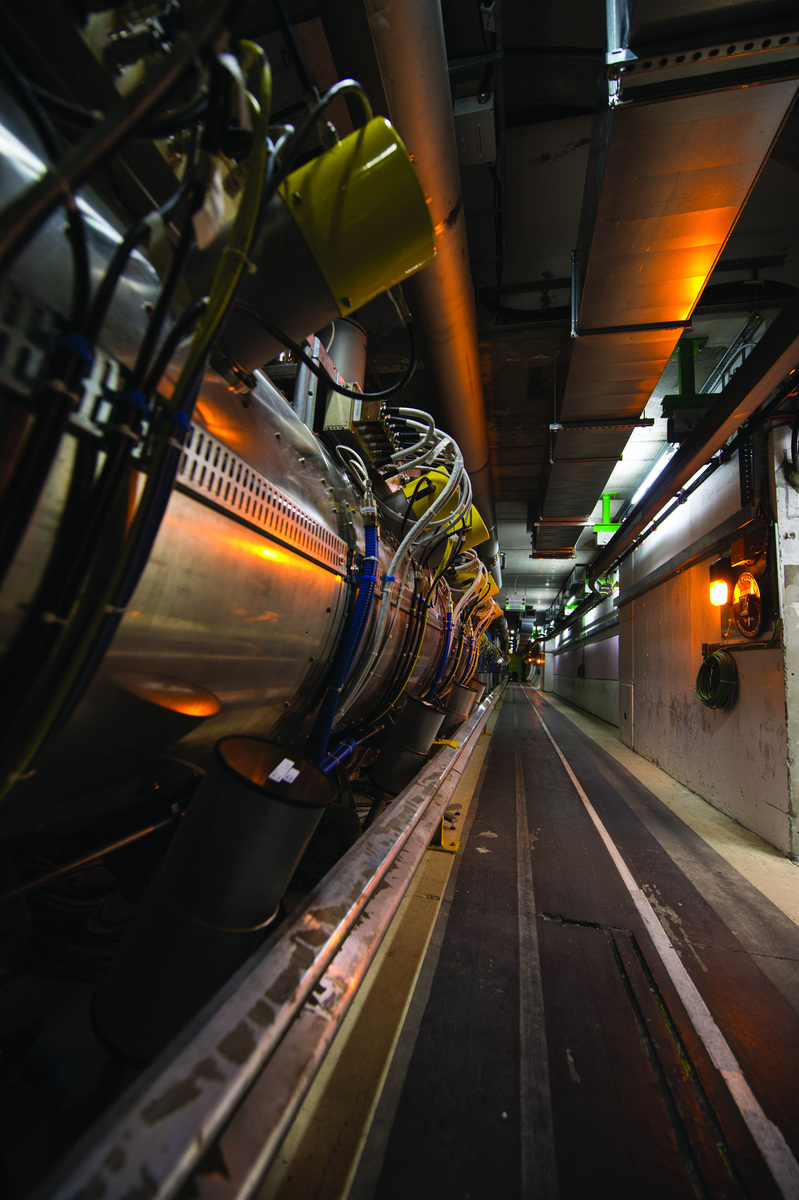
The Large Hadron Collider (LHC) began operating on
2010. Four major experiments are conducted in the 27-kilometer-long LHC tunnel, located 100 meters underground.
Two beams containing ~300 trillion protons (3,000 bunches of 100 billion each) travel at 99.9999991% the speed of light. They complete ~11,000 laps of the accelerator (27 km in circumference) per second and collide each time at the center of the four experiments (ATLAS, ALICE, CMS, and LHC-b detectors).
The CAST Experiment at CERN: CAST (CERN Axion Solar Telescope) is CERN’s only astroparticle physics experiment that has gained international recognition, and it is the only experiment at CERN led by a Greek institution. The CAST international collaboration consists of approximately 60 scientists from Europe, Canada, and the United States. Following the expansion and upgrade, which will be completed shortly, the CAST experiment will be able to search for candidate particles (a) of dark matter (solar axions, as well as “
” axions—background radiation that emerged immediately after the Big Bang), (b) from the “hidden sector” (solar paraphotons), and (c) from dark energy (solar chameleons).
These studies aim to shed light on fundamental problems in modern physics, such as:
— Is there a previously unknown physical phenomenon behind the mystery surrounding the neutron?
— How did the universe come to be in its current form, and how will it evolve in the future?
— Is dark energy the “antigravity” that causes the universe to expand?
In 1999, the process of approving and preparing the CAST experiment began; the experiment collected its first data at the end of 2002. CAST has also been supported by the General Secretariat for Research and Technology (GSRT) since 2000. From the outset, Associate Professor K. Zioutas of the University of Patras has served as the spokesperson for the CAST experiment at CERN.
Konstantinos Zioutas earned a Bachelor’s degree in Physics and a Ph.D. in Experimental Nuclear Physics in Bonn from 1963 to 1972. Since 1976, he has worked at CERN as a Fellow, Corresponding Fellow, and Research Associate. From 1979 to 2005, he served in the Department of Physics at Aristotle University, and in 2005 he became a professor in the Department of Physics at the University of Patras, specializing in “Particle Physics—Nuclear Physics.”
It was the top story of the day across all news agencies and social media platforms. In terms of significance, it was compared to the discovery of DNA. In terms of its impact on the public imagination, it was likened to a descendant of the first mission to the moon. In any case, this is the culmination of half a century of effort, and it took a long journey to reach yesterday’s announcement.
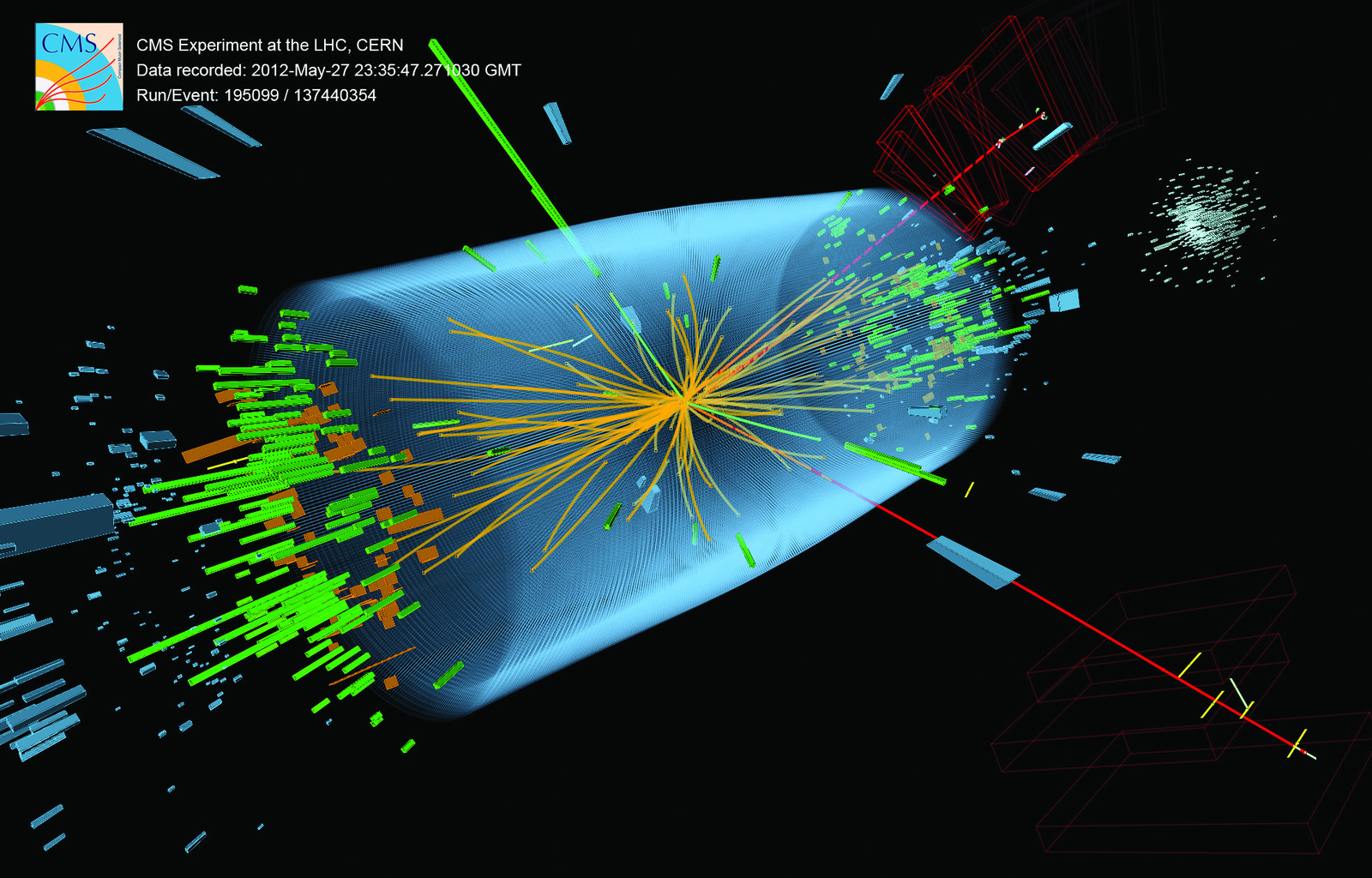
On Wednesday morning, the CERN nuclear research center announced from Geneva that the effort to locate the Higgs particle is nearing its end, revealing that they had discovered a particle in the energy range where the Higgs boson is expected to be found, with behavior similar to what is expected of the Higgs. It now remains to be definitively proven whether the new particle is indeed the long-sought Higgs boson, but the discovery is considered a foregone conclusion by most scientists. Shortly thereafter, Peter Higgs himself—
, now 83 years old—spoke into the microphone at CERN, visibly moved, stating that he never believed this discovery would happen in his lifetime. [Naftemporiki.gr, May 7, 2012]